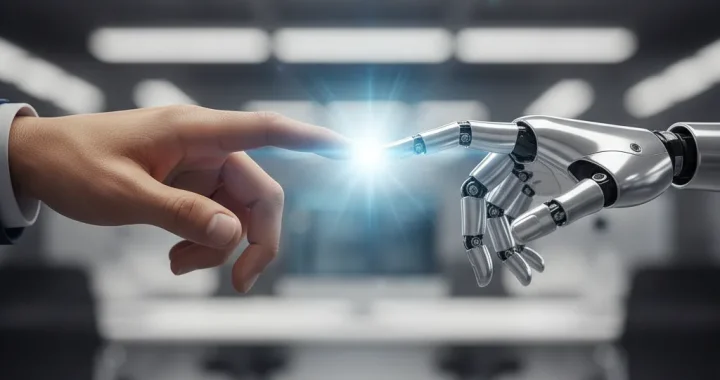
Artificial Intelligence vs Human Intelligence: What’s the Future?
Artificial Intelligence (AI) is revolutionizing our lives, mind, and work. AI is capable of processing faster than a human being, recognizing patterns, and even emulating creativity. Yet, regardless of how far machines develop, human intelligence (HI) will always be unique due to the authority of emotions, ethics, and consciousness.
In this blog, we shall contrast AI with human intelligence by mentioning their strengths, weaknesses, and coexistence in the future.
Introduction:
The Emergence of Smart Machines
In the 21st century, AI went from being science fiction to reality. From autonomous vehicles to voice assistants such as Alexa and ChatGPT, AI is now a dominant force in almost all aspects of our lives.
While AI may be able to process information faster, humans offer something machines do not—feelings, imagination, and ethics. The most critical question is whether the AI would become smarter than humans or whether human and machine coexistence would take place.
What Is Artificial Intelligence (AI)?
Artificial Intelligence (AI) describes the capacity of machines to simulate human thinking and decision-making. It comprises machine learning from data, pattern detection, problem-solving, and prediction without human oversight.
Key Characteristics of AI:
- Learning from data: AI gets better with the study of large sets of data.
- Speed and accuracy: It computes millions in a second.
- Automation: It does the same thing multiple times automatically, thereby saving humans’ work.
- Adaptive: Machine learning enables AI to learn through experience.
Real-Life Examples of AI:
- Virtual assistants (Siri, Alexa, Google Assistant)
- Customer service chatbots
- Driverless cars
- Facial recognition software
- Predictive diagnostics in healthcare
What Is Human Intelligence (HI)?
Human Intelligence refers to the capability of human beings to think, reason, learn, and adapt in terms of experience and emotions. HI includes conscious knowledge, emotional intelligence, and moral reasoning—capabilities beyond machines yet.
Essential Features of Human Intelligence:
- Emotional intelligence: Humans possess empathy, love, fear, and motivation.
- Imagination and creativity: Capability to generate, innovate, and rationalize beyond logic.
- Versatility: Able to respond to new and unforeseen circumstances in a proper manner.
- Moral reasoning: Humans have the ability of knowing right and wrong.
Human intelligence is not only knowledge but also incorporates intuition, culture, and emotional balance.
AI vs Human Intelligence: Main Difference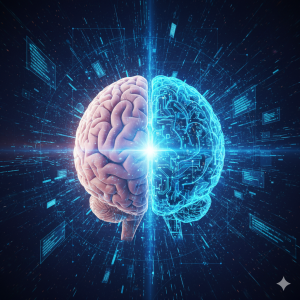
The following are the main differences between human and artificial intelligence.
Dimension Artificial Intelligence (AI) Human Intelligence (HI)
Learning Source Data and algorithms Experience and emotions
Speed Quick information processor Slower but more flexible
Decision-Making Logical and factual Emotional and instinctive
Creativity Restricted to available data Innovative and creative
Emotions No emotions Emotionally aware
Adaptability Performs best under fixed conditions Adapts well to change
Ethics and Morals Programmed Naturally developed
Error Handling Low chance of error Prone to human error
Purpose Task-specific Multidimensional
This graph shows that as AI is more efficient and quicker, humans have depth, empathy, and knowledge that machines can never achieve.
The Strengths of Artificial Intelligence
AI provides breathtaking strengths that make it an integral part of our future digital world.
1. Accuracy and Efficiency
AI can perform repetitive work endlessly without fatigue, increasing efficiency and decreasing errors. For example, in manufacturing, AI-powered robots can produce products with precision to perfection.
2. Data Processing Power
AI can process huge amounts of data within seconds—something which is humanly not possible. For example, AI machines can detect diseases like cancer by recognizing medical images more quickly and efficiently.
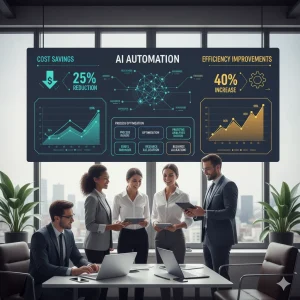
3. Availability
AI systems never need rest and sleep. They can operate 24/7 without any decline in efficiency.
4. Cost-Effectiveness
Once installed, AI can minimize long-term expenses through automation and minimizing manual intervention.
5. Risk Management
AI is capable of executing perilous tasks in dangerous environments, such as traveling to space or defending against toxins, without putting human lives at risk.
The Superiority of Human Intelligence
Humans have abilities that machines can never aspire to match even with AI’s processing speeds.
1. Emotional Intelligence
Humans have the ability to empathize, form relationships, and understand emotions—a critical factor in leadership, communication, and teamwork.
2. Creativity and Innovation
AI can only create based on what it already knows, but human beings can build completely new concepts. Creativity is still a human advantage when it comes to things such as art and technology.
3. Moral and Ethical Decision-Making
Human beings base decisions on ethics and values, not information. For instance, doctors consider the emotional needs of patients and ethical factors before deciding on procedures—something that AI does not.
4. Flexibility and Adaptability
Humans can adapt readily to unexpected changes or new settings, while AI is handicapped outside its realm of programming.
5. Lifelong Learning
Humans can learn from experience, emotional experience, and from social interaction—making learning deeply personal and transformative.
The Risks and Challenges of AI
Even as AI holds many promises, challenges have arisen that pose ethical and societal concerns.
1. Job Displacement
Automation poses a significant portion of jobs, particularly in fields such as customer service, transportation, and production.
2. Bias in Algorithms
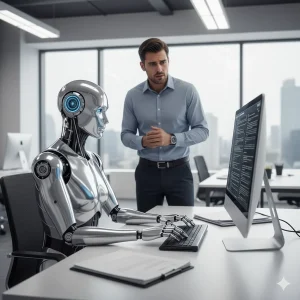
AI is trained using data that is currently available; if the data is discriminatory, then AI will discriminate in its judgment. Recruitment software, for example, can discriminate against some races or genders.
3. Privacy and Security Threats
AI tends to use personal information, hence implying privacy breaches and surveillance concerns.
4. Technology Over-reliance
Reliance on AI can suffocate human creativity, critical thinking, and decision-making abilities.
5. Ethical Issues
Who’s fault is it when AI makes a mistake—the user, the consumer, or the machine?
How AI and Human Intelligence Can Work Together
Rather than competing, humans and AI can complement each other. This is called “Augmented Intelligence,” where AI augments human performance instead of replacing it.
How AI and Humans Can Work Together:
- Decision Support: AI does data processing, and humans make the judgment.
- Creative Support: AI aids creatives, writers, and designers in idea generation.
- Healthcare: Doctors are aided by data analysis from AI, while human beings provide empathy and compassion.
- Education: AI customized learning so that teachers can have the job of guidance and encouragement.
- Business: AI gets things done, but human beings take care of leadership and strategy.
The optimal results are obtained when technology serves humanity and vice versa.
The Future: Will AI Exceed Human Intelligence?
This is a popular question these days. Most people believe that AI will continue to advance and could become or even exceed human-level intelligence—a condition referred to as Artificial General Intelligence (AGI).
AGI does not imply that AI would think and feel like a human. Even the most sophisticated AI lacks:
- Depth in feelings
- Moral judgment
- Experience of consciousness
Future Possible Scenarios:
- Harmony: Humans and AI collaborate towards development.
- Competition: AI steals some jobs and decision-making tasks.
- Collaboration: AI improves human creativity and innovation.
The future is up to our responsible AI development and implementation.
Conclusion: Finding the Balance Between AI and HI
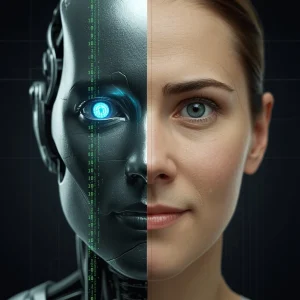
AI is faster, smarter, and better, but human minds are emotional, imaginative, and ethical. Rather than viewing AI as a threat, we can view it as a human development tool.
In brief:
- AI is superior at logic, speed, and automation.
- Humans are better at empathy, imagination, and ethics.
The future is of the ones who manage to blend both together. As technology advances, we need to strive toward a future where AI is augmenting human beings and not displacing them. The equilibrium between artificial and human intelligence will define the next generation’s innovation.