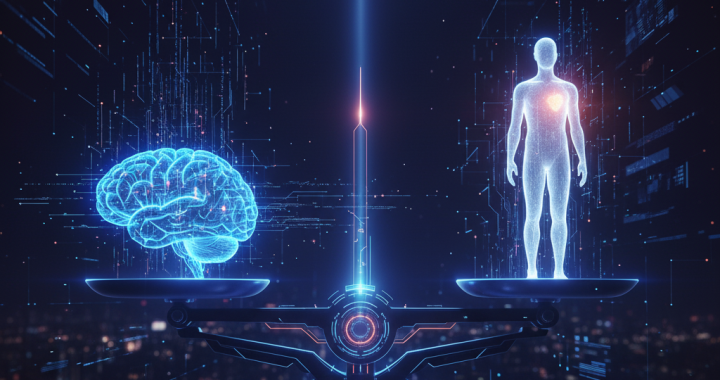
The Ethics of Artificial Intelligence: Balancing Power and Responsibility
1. Introduction:
The Moral Side of Machine Intelligence Artificial Intelligence (AI) is revolutionizing our world — in medicine and schools, business and communications. But, as with great power, comes great responsibility.
As AI systems become increasingly intelligent and self-governing, they present questions of ethics about how far machines should be allowed to go in making decisions similar to human ones.
The arrival of AI is not just a tech revolution — it’s a social and ethical tipping point.
This blog discusses the ethics of AI, emphasizing the need to balance power and responsibility in AI development.
What Are AI Ethics?
AI Ethics is the set of ethical principles that guide the design,  development, and use of artificial intelligence systems.It aims to benefit humanity with AI technologies without doing harm or injustice.
Major Objectives of AI Ethics:
- Promote fairness and justice
- Protect human rights and privacy
- Enforce transparency and accountability
- Prevent discrimination and prejudice
- Promote responsible innovation
Generally, AI ethics provides guidance regarding what is wrong and what is right in the making and usage of smart machines.
Why AI Ethics Matter
Artificial Intelligence promises much — but in the absence of ethical guidance, it can too readily be abused.
From biased hiring practices to surveillance by AI, unethical AI can hurt individuals, perpetuate discrimination, or even dismantle democracy.
Why AI Ethics Matter
- Trust: Humans need to trust AI systems in order to employ them with confidence.
- Safety: Ethics prevents the abuse of AI for harmful uses like autonomous weapons.
- Fairness: Makes sure everyone gets the benefits of technology, not only a select few.
- Accountability: Blames someone when AI goes wrong.
- Ethics makes AI for the benefit of people — and not the other way round.
The Pillars of Ethical AI
Discuss the fundamental pillars of AI ethics that must be adhered to by every organization.
1. Transparency
The AI systems must be explainable and understandable.
The users have the right to know:
- How decisions are made
- What data is used
- Why certain outcomes happen
Transparent AI facilitates trust building and easy detection of errors or bias in the decision-making process.
2. Non-Discrimination and Fairness
- AI must not discriminate on grounds of race, gender, age, or religion.
- Use of discriminatory data for training AI may result in unfair outcomes.
Example: A gender-biased man-favoring recruitment AI system due to discriminatory training data.
3. Accountability

Someone has to be accountable when AI goes wrong.
Ethical AI demands:
Crystal-clear responsibility from developers and institutions Statutory regulation to provide monitoring and compliance
4. Privacy and Data Protection
AI systems are hungry for data.
To be ethical, they need to:
- Respect users’ privacy
- Collect minimum data
- Store and process it securely
- Safety and Security
- AI needs to be designed not to cause harm.
It needs to be:
- Secure and tamper-proof against abuse or hacking
- Periodically programmed to remove errors before release
5. Human Oversight
Human judgment should always be augmented by AI but never substituted for it.
Humans need to remain “in the loop” — particularly in life-or-death areas such as medicine, policing, or finance.
Ethical Challenges in AI in Real Life
AI fuels progress, but at what price: posing difficult moral dilemmas. Some of the biggest ethics issues today are listed below.
1. Bias in AI Algorithms
AI is taught on past information — perhaps involving human bias. That can cause discriminatory results in:
- Employment practices
- Credit ratings
- Police facial recognition
Example: Some AI face recognition systems have higher error rates on darker skin tones — an ethical issue that must be addressed.
2. Privacy and Surveillance
AI-powered surveillance technology has the ability to follow faces, voices, and emotions.
While beneficial to security, it also intrudes on people’s privacy if misused.
Citizens must have control over their data being collected and used.
3. Autonomous Weapons
Artificial intelligence-powered weapons that choose to kill independently are quite detrimental to morals and humanitarianism.
Who gets blamed if an autonomous drone kills a person by accident?
4. Deepfakes and Misinformation
Deepfake, synthetically produced simulated video clips, can be used to disseminate disinformation, manipulate votes, or ruin reputations.
Morality in AI use needs to maintain truth and responsibility of the digital world.
6. Job Displacement
AI-driven automation is displacing human workers.
While AI brings new opportunities, responsible AI needs to provide reskilling, equitable transition, and social assistance to displaced workers.
Organization and Government Responsibility
AI ethics isn’t just a coder’s responsibility — it’s the world’s issue.
Governments, firms, and international institutions are all devising moral guidelines to manage AI.
1. Government Rules
Familiar nations like the European Union have come up with the AI Act, its priorities being:
- Risk-based categorization of AI
- Legislation protecting data
- Severe sanctions for misuse
2. Corporate Responsibility
Google, Microsoft, and OpenAI have formed AI Ethics Committees to provide correct use of AI.
These consist of codes of fairness, transparency, and accountability.
3. Global Cooperation
UNESCO and OECD are establishing universal norms in AI ethics, urging countries to unite for secure AI.
Balance between Power and Responsibility
AI gives humanity unprecedented power — power that will have to be responsibly controlled.
The aim is not to halt AI development, but to steer it with values.
1. Developers’ Responsibility
- Ensure AI conducive to human values.
- Test for fairness and lack of bias in algorithms.
- Employ diverse teams for development to minimize bias.

2. Corporate Responsibility
- Utilize AI responsibly in commercial decisions.
- Be open about how AI affects individuals.
- People over profits.
3. User Responsibility
- Stay informed about how AI works.
- Utilize technology responsibly and not abusively.
- Promote ethical corporations that are justice and privacy-respecting.
The Future of Ethical AI
The future of AI is a balance between ethics and innovation.
We must develop systems that are intelligent yet empathetic, powerful yet governed.
Future Ethical AI Trends:
- Ethical AI Audits – Periodic audits of algorithms for justice and accuracy.
- Explainable AI (XAI) – Models that provide transparent explanations of their decisions.
- AI for Good – Applying AI to social good such as preventing climate change, healthcare, and education.
- AI Accountability Laws – Tougher laws to avoid misuse.
- Human-AI Collaboration – Creating systems that aid themselves with, not replace, human judgment.
The future is in the hands of those who can combine innovation with integrity.
9. Case Study: Ethical AI in Action
Example – AI in Healthcare AI technologies are today utilized to detect cancer, heart disease, and diabetes at an early stage.
But good ethical practice guarantees:
- Patient consent to data usage
- Blind access to healthcare by AI
- Human physicians with the ultimate decision
- This illustrates how ethics principles can render AI useful and trustworthy.
Conclusion: Shaping a Responsible AI Future
- Artificial Intelligence is among the strongest tools human beings have ever devised.

- But without ethics, all that power is risky.
- We need to make AI obey human values, deliver justice, and safeguard privacy.
In brief:
- AI Ethics = Power with Responsibility
- Responsible, ethical, and relational AI is reliable.
- All governments, businesses, and people must all do their part to make sure AI serves the whole.
- The true test isn’t whether AI can do something — but whether it should.
The right, ethical, responsible choice will establish a future that sees technology as an ally of mankind rather than its master.