B2B vs. B2C Email Marketing: Key Differences Explained (2025 Guide)
Email marketing is one of the best ways to reach YOUR audience, increase engagement, and ultimately drive sales, whether it’s B2B or B2C.
But here’s the catch – B2B email marketing is NOT the same as B2C email marketing.
They both have different audiences, use different communication styles, and require different strategies.
In this blog we’ll be looking at the main differences between B2B and B2C email marketing, what works best for each, and expert solutions to help you write emails that convert in 2025.
What is email marketing?
Let’s start with the basics first.
Email marketing is a way of sending emails to a list of people on purpose to either promote a product, deliver an update, or nurture a relationship.
E-mail is still the #1 channel for marketing return on investment in 2025, averaging $42 for every dollar spent.
Although, how you send out your email depends if you’re selling to business or to consumers, B2B or B2C.
What is B2B Email Marketing?
B2B email marketing has its focus on other companies, organizations, or professionals.
The focus is on value creation and long term relationship development, lead generation, and providing informative content that helps your recipient
For example, a software company can email all HR managers with a pitch to sell a new employee management tool, or an agency can send all prospective clients previous case studies from clients they previously partnered with.
The focus of B2B Email is on educate, build trust, and long term value.
What is B2C Email Marketing?
B2C – or Business-to-Consumer, email marketing is focused on the individual customers.
Here, the focus is all things emotional connection, impulse buy, and personalized offers.
For example, a fashion brand sends out a promotional ‘time limited’ discount e-mail or influencer sends their online course to their influencer following.
The focus of B2C Email is on emotion, urgency, and immediate conversion.
1. Target Audience and Decision-Making:
B2B Audience:
- There are multiple decision stakeholders.
- Purchases are logical and data-driven.
- Purchasing decisions can take longer due to the research, comparisons, and demos involved.
B2C Audience:
- Purchases are emotional and impulsive.
- Everyone makes their own purchase decisions.
- Purchasing decisions are short, and impulsive.
Example:
Where a B2B buyer may take a month to have discussions before purchasing a CRM tool, a B2C buyer may impulsively buy shoes using a discount email.
2. Tone and Language
- Professional and informative, and data-focused.
- Tone and language are formal, with industry lexis.
- Purpose: engaging, educating, and establishing authority.
B2C Email:
- Use engaging headlines and storytelling.
- Purpose: entertain, and encourage action now.
Example:
- B2B: “Discover How Our Software Increases Workflows By 45%.”
- B2C: “Your Dream Outfit Is Waiting For You – 30% Off Just For You!”
3. Email Design and Layout: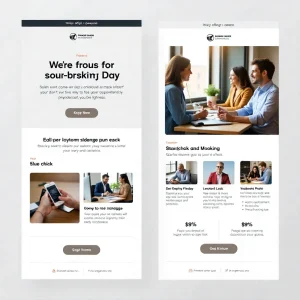
B2B Email:
- They should be clean and minimal.
- The main emphasis should be on the content, stats, and CTAs, e.g., “Request Demo” or “Download
- Whitepaper.”Usually one or two CTAs per email
B2C Emails:
- These emails are full of color, featuring bold undertones, images of items on sale and promotional banners.
- The emails also include various CTAs, such as, “Shop Now,” ‘Get 20% off,” or “Shop New Arrivals.”
Example:
Considering an email as a B2C email, we would likely utilize promotions or colorful graphic images, and a B2B email would likely have graphs, testimonials and success stats.
4. Content Strategy
B2B Email Content:
Utilizing content like, white papers, case studies, ebooks, webinars and valuable industry content that you have curated for your audience that builds your thought leadership.
B2C Email Content:
Content like sharing discounts, seasonal offers, new product launches, loyalty programs and invites to events that specifically lead to immediate conversion.
For example: B2B: “Free Webinar – The Future of Automation in SaaS”
B2C: “Flash Sale! 40% off ends tonight.”
5. Frequency Emails or Timing of Frequency Emails
B2B Emails: These emails are sent less frequently and usually once or twice a week, You can send B2B emails from Tuesday through Thursday during business hours.
B2C Emails: These emails can be sent more frequently or in some cases, daily or a few times a week. You can send B2C emails at night or on the weekends when consumers are looking at the emails more in a casual browsing mindset.
Pro Tip: Use automation to test open rates by time zone for better engagement.
6. Personalization and Segmentation
B2B:
- Personalize content to address pain points and ROI.
- Segment based on company size, job title, or industry.
B2C:
- Segment based on purchase history, location, and browsing behavior.
- Personalize for emotional impact – such as “Recommended for You.”
Example:
B2B: “Hi Priya, here’s a case study on how we helped a SaaS brand like yours.”
B2C: “Priya, you left something in your cart – grab it before it’s gone!”
7. Call-to-Action Strategy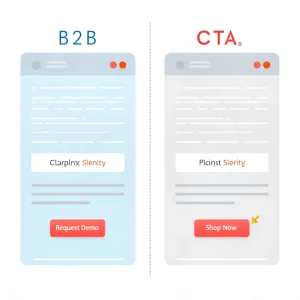
B2B: Focus on lead generation and lead nurturing.
B2C:
- Engage in direct sales and interaction.
- CTAs such as “Shop Now,” “Buy Today,” or “Claim Offer.”
8. Measurement and Tracking Success
B2B Metrics:
- Lead generation rate
- Demo requests
- Click-through on gated content
- Sales-qualified leads
e-commerce B2C metrics:
- Open rates
- Click-through purchase rate
- Coupon redemptions
- Cart recovery rate
Example:
While B2B emails nurture leads, B2C emails are more geared toward closing sales immediately.
How to Execute an Effective B2C Email Campaign
- Use Compelling Visuals – Utilize pictures of the product and lifestyle graphics
- Utilize Urgency and Emotion- Limited time deals promote quick clicks.
- Keep the Copy Short and Sweet- Stick to one main message
- Test Send Times and Subject Lines- Use A/B testing to improve for conversions.
Sample: “Your favorite dress is back in stock— better get it before it’s gone!”
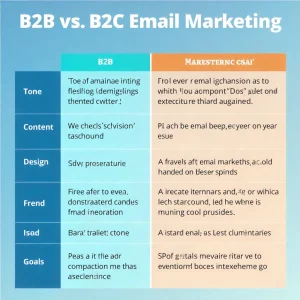
Quick Comparison Table
The Future of B2B and B2C Email Marketing in 2025
Email marketing is changing quickly – and the center of this change centers around artificial intelligence, automation, and personalization.
Future Trends to Look For:
- AI-Driven Personalization: Campaigns that hyper-targeted to interests that are adjusted according to user behavior.
- Interactive Emails: Polls, videos, and product carousels are embedded within an email.
- Behavioral Triggers: E-mails executed to respond to certain triggering events like someone visiting your website or downloading something.
- Predictive analytics: Using AI data to predict what clients will need.
- Privacy first marketing: An increase in the emphasis on GDPR compliance and data safety.
B2B = B2C Marketers and ROI = Automation + Personalization
Conclusion
Choosing the Right Strategy for Your Audience
Both B2B email marketing and B2C email marketing are equally powerful, each one will depend on knowing the frame of mind of your audience.